
For the first time, the United States Supreme Court is poised to answer a question that directly impacts millions of responsible Americans:
Are modern, commonly owned semiautomatic rifles, including the AR-15 platform, protected under the Constitution?
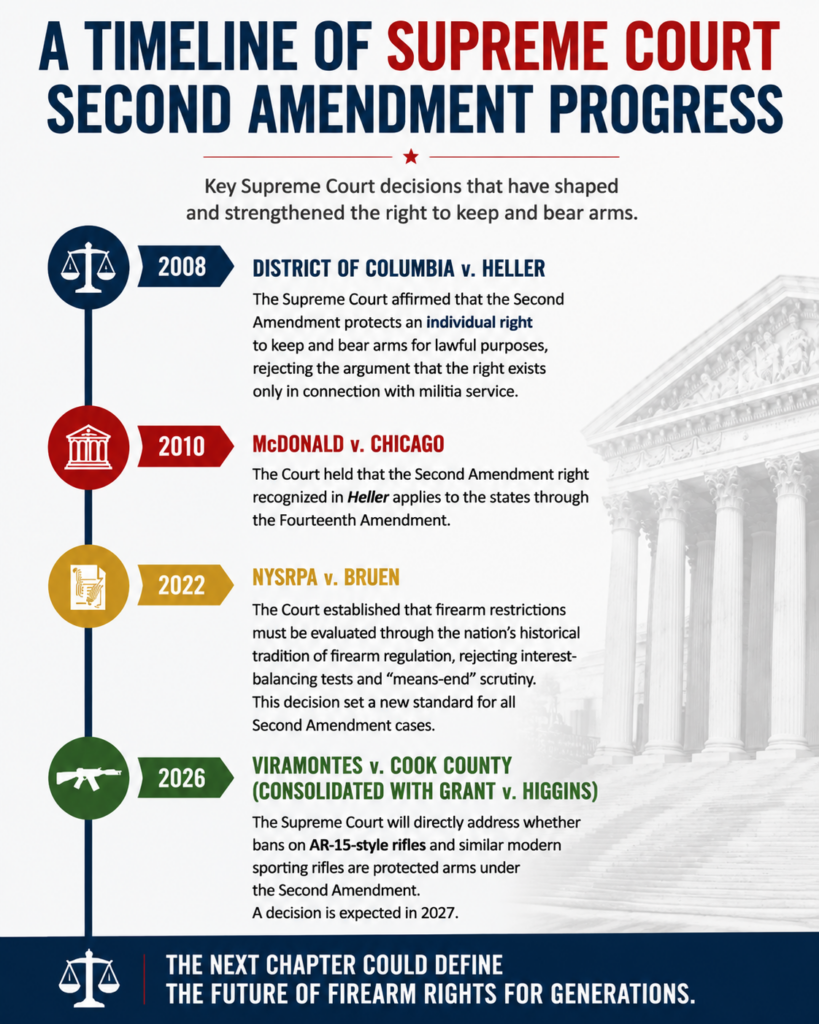
The Court granted review in Viramontes v. Cook County, a case challenging an Illinois ban on AR-15-style rifles and similar semiautomatic firearms. The Court consolidated the case with Grant v. Higgins and will hear oral arguments during its upcoming term, with a decision expected in 2027.
While this case started in Illinois, what happens next will affect families, communities, and freedoms across the country—especially here in California, where the stakes for gun owners have never been higher.
The Missing Piece After Heller and Bruen
The Supreme Court has spent nearly two decades defining the scope of the Second Amendment.
In District of Columbia v. Heller (2008), the Court confirmed that the Second Amendment protects an individual right to keep and bear arms.
In McDonald v. Chicago (2010), the Court confirmed that this right applies to state and local governments.
Then, in New York State Rifle & Pistol Association v. Bruen (2022), the Supreme Court established the standard courts must use when evaluating firearm restrictions: the government must demonstrate that a restriction is consistent with the nation’s historical tradition of firearm regulation.
But one major question remained unanswered:
What modern firearms are protected by the Second Amendment?
That is the question now before the Court in Viramontes.
Why This Case Matters to California
California has some of the most restrictive firearm laws in the country, including its assault weapons ban, which restricts commonly owned rifles based largely on specific features and configurations.
California has long argued that it is not banning the AR-15 itself. Instead, the state claims it is simply regulating certain features, including:
- Pistol grips
- Adjustable stocks
- Flash hiders
- Other commonly used firearm components
However, if the Supreme Court determines that AR-15-style rifles are protected arms under the Second Amendment, California’s approach could face serious constitutional challenges.
The question becomes:
Can a state allow ownership of a firearm while prohibiting the standard configuration in which millions of Americans own and use that firearm?
“Gun Owners of California and Gun Owners of America are excited to see the Supreme Court finally take up a case directly addressing AR-15-style rifles and other commonly owned modern sporting rifles. This case can have tremendous ramifications for California gun owners and law-abiding citizens nationwide.”
— Adam Wilson, California Director, Gun Owners of America / Gun Owners of California
A Test of Whether Courts Will Follow Bruen
This case also represents a major test of whether lower courts are properly applying the Supreme Court’s Second Amendment decisions.
Since Bruen, the Supreme Court has made clear that firearm restrictions must be evaluated through the text, history, and tradition of the 2nd Amendment at the time of the founding, not through a balancing test where courts weigh public safety interests against constitutional rights.
However, many Second Amendment cases continue to face challenges in lower courts, where judges have relied on reasoning similar to the interest-balancing approach that Bruen rejected.
Critics of those decisions argue that some courts have attempted to preserve prior conclusions by relying on narrow historical comparisons or by focusing on policy arguments rather than the constitutional analysis required by the Supreme Court.
Viramontes gives the Supreme Court a chance to remind every judge in America: Bruen isn’t just advice—it’s the law. When our rights are at stake, courts must follow the Constitution, not subjective opinions or politics.
Why AR-15-Style Rifles Are at the Center of the Debate
Much of the dispute surrounding this case will focus on whether AR-15-style rifles are protected arms.
Opponents of these firearms frequently describe them as “weapons of war.”
The reality is that AR-15-style rifles are semiautomatic firearms that fire one round per trigger pull. They are among the most commonly owned rifles in America and are lawfully used by millions of citizens for self-defense, training, competition, and recreation.
The real question isn’t about appearances or labels—it’s about whether millions of responsible Americans legally own and use these firearms. That’s what the Constitution protects, and that’s what’s at stake for every California gun owner.
California’s Likely Response: Finding Workarounds
Even with a favorable ruling, the legal fight will likely continue.
California has a long history of modifying firearm restrictions in response to court decisions, and a ruling protecting AR-15-style rifles could lead to new arguments focused on features, accessories, or configurations.
The state’s argument may become, “You can own an AR-15, but you cannot have these features.”
That’s why every word in the Supreme Court’s opinion will matter for real people, not just lawyers and politicians.
“We know California won’t give up its restrictions easily—even if gun owners win. The state has a history of finding new ways to stand in the way of our rights. That’s why we need the Supreme Court to send a clear, strong message that the Constitution comes first, above political gamesmanship.”
— Adam Wilson, California Director, Gun Owners of America / Gun Owners of California
The Court will need to address whether governments can avoid constitutional protections by banning the common configuration of a protected firearm while allowing only government-approved alternatives.
The Arguments We Can Expect
Opponents of AR-15 protections will likely make many of the same arguments heard after previous Supreme Court Second Amendment decisions.
They will argue that protecting these firearms threatens public safety.
Similar predictions were made following Heller, McDonald, and Bruen. Yet those decisions remain the law of the land, and the predicted collapse of public safety has not occurred.
The debate ultimately comes down to a fundamental constitutional question:
Can a government prohibit firearms that are commonly owned and lawfully used by millions of Americans simply because it disagrees with them?
What Happens Next?
Regardless of the outcome, this case will likely trigger additional litigation nationwide.
A ruling favoring the petitioners could impact:
- Assault weapons bans
- Feature restrictions
- Firearm classification laws
- Other restrictions founded on the idea that certain commonly owned firearms are outside Second Amendment protection
For California, the impact could be especially significant.
The state’s firearm regulations have regularly relied on limiting access through definitions, features, and classifications instead of outright prohibitions. A Supreme Court decision addressing the constitutional status of modern sporting rifles could fundamentally change that landscape.
Why This Case Is Historic
The Supreme Court has answered several foundational Second Amendment questions:
- Heller: Is there an individual right to keep and bear arms? Yes.
- McDonald: Does that right apply to states? Yes.
- Bruen: How should courts analyze firearm restrictions? Through historical tradition.
Now the Court is being asked the next major question:
Does the Second Amendment protect the firearms commonly owned by Americans today?
For every gun owner in California, this case could be the turning point—the moment that defines what freedom looks like for generations to come.
The Supreme Court now has the chance to deliver the clarity alongside justice that gun owners, families, and communities across California have been demanding for years.
Gun Owners of California and Gun Owners of America will continue fighting California’s anti-gun agenda in the courts and the Legislature. With major cases like Viramontes before the U.S. Supreme Court, the future of the Second Amendment in California is very much in play. If you support this fight, please consider standing with GOC and helping us press forward. Donate HERE. Donate to GOA HERE.